2WD vs 4WD Tractor: Which One Should You Buy in India?
Aglist Editorial · Published 11 Aug 2026 · Last updated 23 Sep 2026
Four-wheel drive costs more to buy and more to maintain. On wet fields, slopes, loader work and heavy haulage it pays that back. On flat dry land with a rotavator, it does not.
A 4WD tractor sends power to the front axle as well as the rear. That is the whole difference, and everything else follows from it: more grip where grip is scarce, more parts to service, more money at purchase. Whether it is worth it has nothing to do with how modern you want your tractor to look, and everything to do with the ground you work on.
What the front axle actually costs
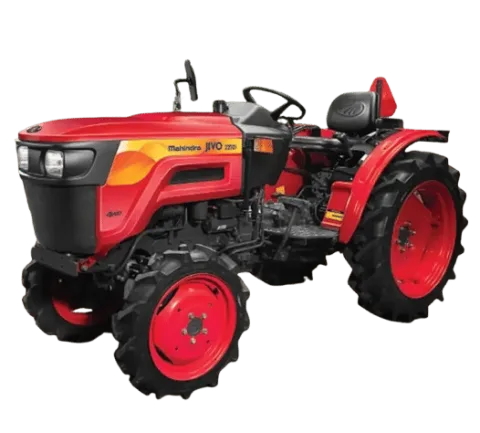
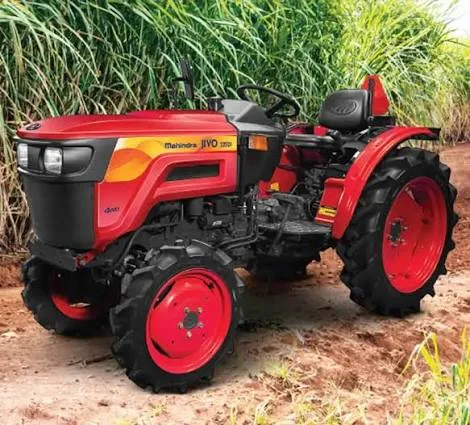
We can only quote a like-for-like premium where the same model exists in both drives. On this catalogue there is one such pair. The Mahindra JIVO 225 DI is listed at Rs 4.32-4.53 lakh in 2WD, and the JIVO 225 DI 4WD at Rs 4.63-4.78 lakh. That is a gap of roughly Rs 25,000-30,000 on a 20 HP machine.
On mainstream 45-55 HP tractors the gap is larger, because the front axle, differential and heavier front tyres all scale with the machine. We are not going to put a percentage on it, because we do not have a sourced figure covering the whole market and inventing one would be worse than useless. Get the two quotes from your dealer in writing on the same day and compare them yourself.
What we can say is that the purchase premium is not the whole cost. A driven front axle adds a differential, a transfer arrangement, more oil seals and two larger front tyres to replace when they wear. Ask your dealer what the front axle service interval is and what a front tyre pair costs before you decide.
Where 4WD genuinely earns its money
Wet and puddled fields. Getting a loaded trolley off a soft field onto a hard road is the classic 4WD moment. Note the nuance though: in the middle of a puddled plot the front wheels are mostly steering rather than pulling, so 4WD helps you get out of trouble more than it helps you work. Our paddy and puddling guide explains why cage wheels and rear ballast matter more there.
Slopes and terraced land. Undulating upland plots in Jharkhand, hill and plateau farming, coffee and arecanut country in Karnataka, terraced vineyards. Here 4WD is not a comfort feature, it is a safety and traction requirement.
Front loader work. If you run a loader, buy 4WD. A loaded bucket transfers weight forward and lifts load off the rear wheels, which is exactly when a 2WD stops pulling. This is the single least arguable case for four-wheel drive.
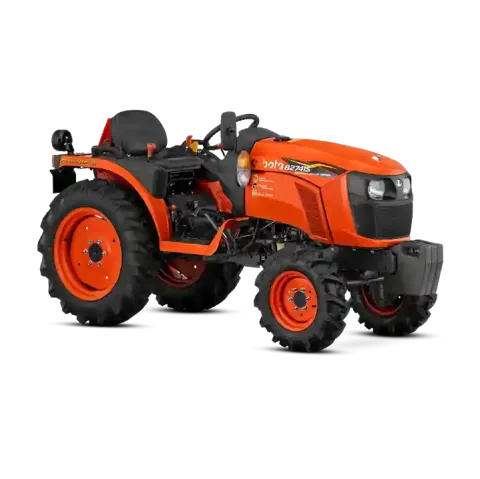
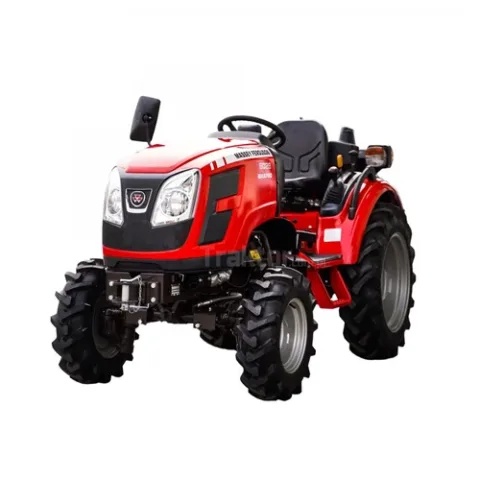
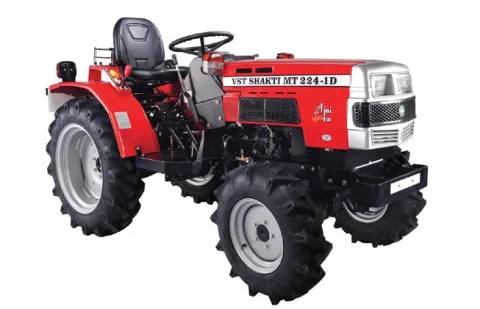
Orchards and vineyards on soft or sloping ground. Compact 4WD machines are built for this: the Kubota NeoStar B2741S 4WD at 27 HP, the VST MT 224 1D 4WD at 22 HP, the Massey Ferguson 6028 4WD at 28 HP, and the Mahindra JIVO 245 DI 4WD at 24 HP. Browse the whole mini tractor range to compare them.
Heavy haulage on kutcha roads. Loaded trolley, wet approach track, gradient at the end. A 2WD can be recovered with ballast and care. A 4WD does not need recovering.
Where 4WD is money wasted
Light dry soils. Sandy and arid land, of the kind that dominates much of Rajasthan, does not usually defeat a 2WD. Rajasthan is India's third largest tractor market by volume and it buys mainly in the 35-50 HP range without needing four-wheel drive to do it.
Mostly stationary PTO work. A thresher, a chaff cutter or a pump does not care how many wheels are driven. If your tractor spends most of its hours belted to something that stands still, you are buying an axle you will never load.
Flat, level, well-drained plots. Rear ballast, correct tyre pressure and proper implement setup solve most traction complaints on level ground, and all three are far cheaper than a front axle.
Tight budgets where the money buys something better. Rs 30,000 to Rs 1 lakh, depending on the class, buys oil-immersed brakes, a better gearbox, or simply a lower loan. Read our tractor loan and EMI guide to see what that difference does to your monthly outgo over five years.
Before you pay for 4WD, try fixing traction for free
A surprising number of traction complaints are setup problems wearing a 2WD badge. Work through these first:
- Rear tyre pressure. Field pressure and road pressure are not the same, and an over-inflated rear tyre in soft ground has a much smaller footprint than it should.
- Ballast. Water in the rear tyres or cast wheel weights put load exactly where you need it. This is the cheapest traction you will ever buy.
- Top link adjustment. On a mounted implement the top link setting shifts draft, and correct setting transfers weight onto the rear wheels instead of lifting them.
- Drawbar height for trolley work. A high hitch point lifts the front and unloads the rear axle at the same time.
If all four are right and you are still slipping, then you have a real 4WD case.
The subsidy angle most buyers miss
Under the SMAM tractor subsidy pattern, the ceilings are higher for 4WD than for 2WD in the same PTO HP band. For a 20-40 PTO HP tractor, a general-category farmer's ceiling is around Rs 2.00 lakh for 2WD against Rs 2.40 lakh for 4WD, and for reserved categories at 50% the gap runs from about Rs 2.50 lakh to Rs 3.00 lakh. Those ceilings come from guidelines of 2018-19 vintage and may have been revised since, so verify the current figure before relying on it. Our subsidy guide explains the process and its very real allocation limits.
Things to check at the dealer
- Turn the tractor lock to lock with drive engaged and with it disengaged. Front axle geometry differs between models, and the headland turning circle is what you will live with every day.
- Ask whether 4WD engages on the move or only when stationary, and whether it is mechanical or electro-hydraulic.
- Check that your existing implements clear the front axle when mounted and lifted.
- Ask what the front tyres cost. They are not cheap and they are not a standard size across brands.
Our verdict
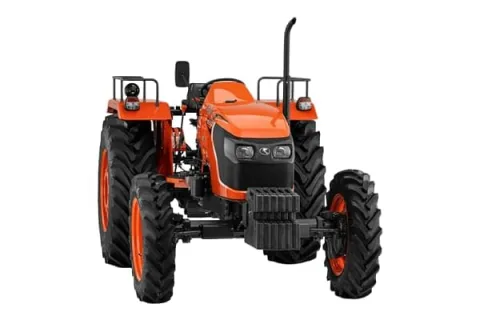
The honest split is this. If your land is flat, dry and level, and your heaviest job is a rotavator and a trolley, buy 2WD and spend the difference on brakes, gearing or a shorter loan tenure. The Kubota MU4501 2WD at 45 HP and the mainstream 41-50 HP 2WD field are more than enough farm for most Indian holdings.
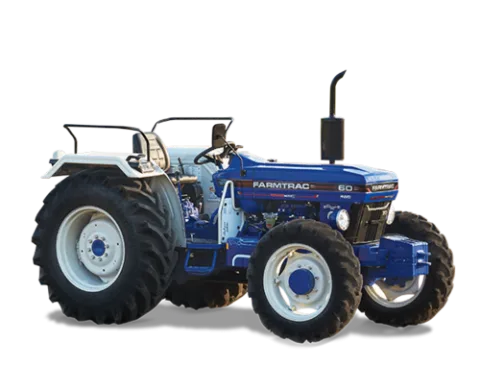
If you work wet ground, slopes, or a loader, buy 4WD and do not agonise over it. The Farmtrac 60 Powermaxx 4WD at 55 HP with a 2,500 kg lift is the full-size 4WD on this catalogue at Rs 9.15 lakh, and for the right farm it is not expensive at all.
Work out how much HP you need first. Drive type is the second decision, not the first, and buyers who reverse that order usually end up with too much tractor and too little gearbox.