Tractor Loan Interest Rate and EMI Guide (India 2026)
Aglist Editorial · Published 14 Aug 2026 · Last updated 23 Sep 2026
Bank rates, NBFC rates, LTV, tenure and documents, with the EMI formula worked through on a real example. Plus the traps: flat rates dressed as low rates, bundled insurance, and the margin that is not what you think.
A tractor loan is priced two different ways in India depending on who lends. Banks treat it as agriculture and priority-sector credit, so rates are lower. NBFCs treat it as asset finance, charge more, and approve files that a bank branch would send home. That is why NBFCs hold a large share of tractor finance in markets where documentation is thin.
Rates below are as reported on 21 August 2026. Some lenders we are deliberately leaving out, and we explain why.
What banks are charging
Public sector banks
- Canara Bank: 9.15% - 11.85% p.a., tenure up to 9 years
- Central Bank of India: 9.50% - 11.15% p.a., up to 9 years
- Indian Overseas Bank: 9.65% - 10.50% p.a., up to 9 years
- Union Bank of India: 9.60% - 12.10% p.a., up to 9 years
- Bank of Maharashtra: 10.70% - 11.70% p.a., up to 7 years
- Bank of India: 11.70% - 12.70% p.a., up to 9 years
Private sector banks
- Kotak Mahindra Bank: 8.95% - 26% p.a. Note the width of that band. The 8.95% is a floor for the strongest files.
- Karur Vysya Bank: 9.90% p.a., up to 7 years
- IDBI Bank: 9.60% - 10.60% p.a., up to 9 years
- Federal Bank: 10.85% - 14.40% p.a., up to 10 years
Lenders we are not quoting. We have rate figures for SBI, HDFC Bank, Axis Bank and Magma Fincorp in our research and we are not publishing them. The SBI figures conflict between sources. The HDFC range carries a 2021 vintage stamp. The Axis and Magma vintages are unclear. Publishing a stale rate as current is how a farmer ends up walking into a branch with the wrong expectation, so ask those lenders directly for a current quote.
For NBFCs, Mahindra Finance and L&T Finance are both major tractor financiers, but we could not verify their current published rates and will not invent a range for them.
One more caution. You will see "starting from 8.80%" style headlines quoted by aggregators. Treat a starting-from rate as a marketing floor, not the rate you will be offered.
LTV, margin, and the number that surprises people
The standard bank position is financing up to 90% of the tractor price, meaning a margin, or down payment, of about 10% from you. Some NBFCs stretch to 90-95%. SBI specifies a 15% margin. You will also find a claim online that SBI offers 100% finance; it conflicts with the 15% margin figure in the same source family, so do not plan around it.
Here is the part almost no calculator tells you. Lenders generally compute LTV on the invoice or ex-showroom value, not on the on-road price. So your actual cash requirement at delivery is the margin on the invoice plus the entire registration, insurance, plate and handling stack, which nobody is financing. On a Rs 7.5 lakh machine, a 10% margin is Rs 75,000, and the on-road add-ons can add another Rs 10,000-35,000 in an exempting state. Our RTO and on-road charges guide breaks that stack down line by line.
Tenure and repayment structure
Across lenders, tenure runs from 12 months to 9 years, with Federal Bank going to 10. The commercial norm for a new tractor is 5 to 7 years.
But many agricultural tractor loans are not on monthly EMI at all. They are structured on half-yearly or seasonal repayment, timed to harvest income, because that is when a farmer actually has money. A monthly EMI calculator will mislead you if your loan is written that way. Ask the lender which convention applies before you sign anything.
Eligibility and documents
- Land holding: SBI requires 2 acres; HDFC, Axis and ICICI require 3 acres. Non-farmers face different criteria.
- Age: generally 18 to 60 at funding, with Axis quoted at 21 to 75.
- Income: one source cites Rs 1,00,000 minimum annual income for farmers and Rs 1,50,000 for non-farmers. We would treat that as indicative only.
- Documents: land records, Aadhaar and KYC, bank statements, and the dealer's proforma invoice.
- Processing fee: SBI 0.5% of the loan amount; the general range across lenders is 0.5% to 2%, plus documentation and stamping.
The EMI formula, worked through
EMI = P × r × (1 + r)^n / ((1 + r)^n − 1)
Where P is the principal, r is the monthly rate (annual rate ÷ 12 ÷ 100) and n is the number of monthly instalments.
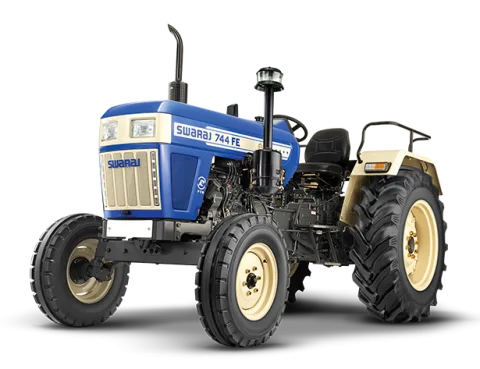
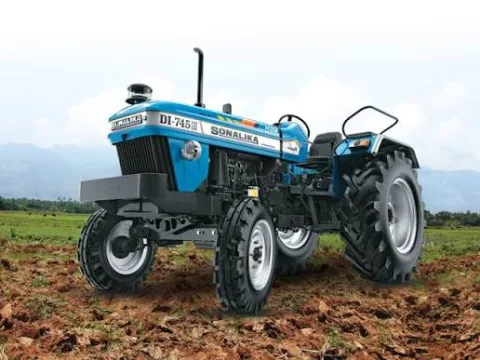
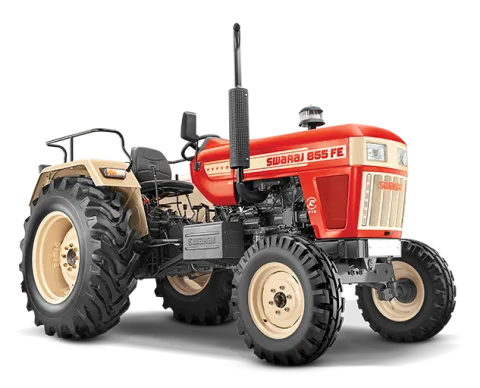
Take a real case. A mainstream 45-50 HP tractor such as the Swaraj 744 FE or Sonalika 745 DI III Sikander lands around Rs 7.5 lakh on the road.
- On-road cost: Rs 7,50,000
- Margin at 10%: Rs 75,000 down payment
- Loan principal P: Rs 6,75,000
- Rate: 10.5% p.a., so r = 0.105 ÷ 12 = 0.00875
- Tenure: 5 years, so n = 60
That gives an EMI of approximately Rs 14,510. Over sixty months you repay roughly Rs 8,70,600, of which about Rs 1,95,600 is interest. Call that figure indicative: your actual EMI depends on the lender's rate, whether fees are capitalised, and the rest convention used.
For a half-yearly seasonal schedule, substitute r = annual rate ÷ 2 ÷ 100 and n = tenure in years × 2. The instalment is much larger but it lands when your crop money does.
The traps
Flat rates dressed up as low rates. This is the big one. A "7% flat" quote sounds cheaper than 10.5%. Do the arithmetic. Flat interest on Rs 6,75,000 at 7% for 5 years is Rs 2,36,250, giving a total of Rs 9,11,250 and a monthly instalment of Rs 15,187. The 10.5% reducing-balance loan above costs you Rs 8,70,600 in total and Rs 14,510 a month. The "7%" is the more expensive loan. Always ask whether a quoted rate is flat or reducing balance.
Bundled insurance and extras. Lenders require comprehensive cover while the loan is live, which is reasonable. What is less reasonable is a multi-year policy, an extended warranty and accessories all being financed into the principal without a clear conversation, because you then pay interest on them for five years.
Processing fees capitalised into the loan. A 2% fee on Rs 6,75,000 is Rs 13,500. Added to the principal, it accrues interest for the full tenure.
Assuming the subsidy reduces your down payment. It usually does not. Under the 2024 CRM guidelines, assistance is credit-linked and back-ended, paid to the lender after physical verification. Our subsidy guide explains the timing, which is often 30 to 60 days after verification under SMAM.
Borrowing for horsepower you will not use. The cheapest interest is the interest you never pay. Every extra Rs 1 lakh of tractor at 10.5% over 5 years costs you roughly Rs 29,000 in interest alone. That is a reason to read our HP guide and the 2WD vs 4WD comparison before you finalise the specification, not after.
Before you sign
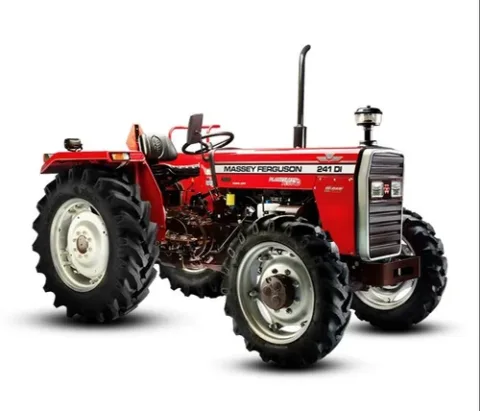
Get the quotation itemised. Ask for the rate in writing with the word "reducing" or "flat" against it. Ask what the processing fee is and whether it is being added to the loan. Ask whether repayment is monthly or seasonal. And check the ex-showroom price you are being financed against on a neutral source, such as our pages for the 41-50 HP band, the Mahindra 575 DI XP Plus or the Massey Ferguson 241 DI Maha Shakti, before the finance paperwork fixes it.