Shuttle Shift vs Synchromesh: How to Read Tractor Gearbox Specifications in India
Aglist Editorial · Published 2 Oct 2026 · Last updated 21 Oct 2026
A shuttle, a synchronised gearbox and a gear-count label describe different things. Use real Indian manufacturer examples and a dealer worksheet to compare the actual transmission package.
A tractor advertisement can say “constant mesh with synchro shuttle” without contradicting itself. The words describe different parts or functions of the transmission. Buyers get into difficulty when they turn one label into a promise about every gear change, or treat a bigger gear count as proof that the tractor will finish a job faster.
The useful question is not simply whether shuttle shift or synchromesh is better. Ask which changes are synchronised, which controls select speed and direction, and which operating sequence the exact tractor requires. This guide helps you prepare that conversation. It is not a substitute for the delivered machine's operator manual.
Read three separate lines in the specification
First, identify the main transmission description. Terms such as constant mesh or synchromesh concern gearbox design and the way particular changes are made. Second, identify the direction-selection arrangement, which may be described as a shuttle or reverser. Third, record the number of forward and reverse ratios and any optional ranges.
These lines should not be collapsed into one conclusion. “Synchro shuttle” does not by itself establish that all speed gears and ranges are synchronised. Nor does “synchromesh” establish that changes may be made without using the clutch or under any load. Ask the supplier to identify the exact scope in the manual rather than relying on a shortened sales description.
What Indian manufacturer examples show
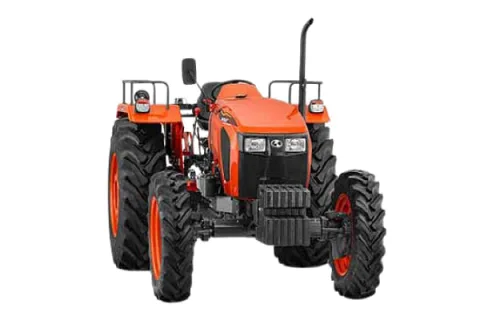
Mahindra's OJA 2127 page lists constant mesh with synchro shuttle and 12F + 12R. Kubota's MU5502 2WD page describes 12F + 4R with synchromesh in the main transmission. These wordings give different information; neither alone is a complete driving instruction.
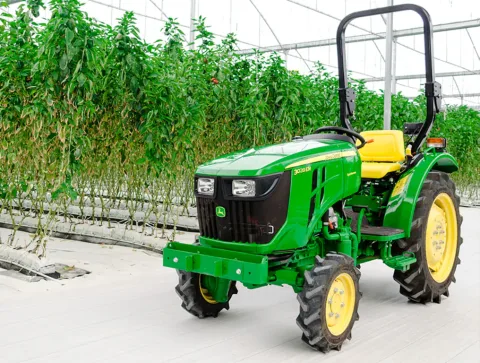
John Deere's 3028EN page lists 8F + 8R with FNR Sync Reverser / Collar Reverser wording. The slash is a reason to clarify the offered version, not to assume both are fitted. Our 3028EN buying guide discusses that configuration question, while the MU5502 guide separates gearbox and PTO considerations.
Even one nameplate may cover different packages. The linked Indian OJA Compact leaflet lists several gearbox choices for the OJA 2130. A model name on a quotation is therefore not enough to identify its transmission.
What 12F + 12R does not tell you
The label tells you the published count of forward and reverse ratios. It does not give the spacing between ratios, every usable working speed, or the procedure for changing direction. It also does not prove that equal-numbered forward and reverse choices produce identical ground speeds.
Request the speed chart for the specified tyres and configuration. Mark the speed range your implement needs, then identify the available choices within it. A tractor with more total gears might add ratios outside your useful working band. Conversely, a closer choice within that band can matter more than an impressive maximum transport speed.
Do not calculate field output from the gear count. Turning time, implement setup, soil, operator familiarity and interruptions all influence a working day. A short demonstration can show whether the controls and ratios suit the job; it cannot establish an annual saving without a much fuller record.
Match the gearbox to the repeated task
For row work with frequent changes of direction, focus on the complete sequence the operator repeats. Where is the direction lever? Which pedal and gear actions are required? Can the operator see the attachment and use the controls comfortably from the proper seated position? Ask the dealer to demonstrate the prescribed procedure and explain any restrictions.
For continuous soil preparation, focus on finding a suitable forward working speed at the implement's required PTO setting. Direction changes may be less frequent, so a convenient shuttle cannot compensate for an unsuitable working ratio. For very slow tasks, ask whether a creeper arrangement is fitted and approved for the intended job; a feature pictured online may be optional.
For mixed work, make two lists rather than searching for a universal winner. Write the controls and speed needs of your most frequent task, then the requirements of the occasional task that you cannot outsource. Compare how each quoted configuration meets both lists. Do not let an attractive feature for an imagined future job decide the whole purchase.
Keep PTO and transmission claims separate
A direction shuttle changes the travel-direction selection; it is not the same specification as PTO engagement or PTO speed. Electric PTO controls, automatic PTO switching and an independent PTO description each need their own explanation for the installed machine. Do not infer them from the gear count or shuttle badge.
Similarly, engine speed, ground speed and PTO shaft speed are different quantities. Ask the supplier to show how the chosen working gear and the implement's required shaft speed are achieved together. Do not improvise by selecting a higher PTO mode or slowing the engine purely to make the tractor travel at a preferred pace. The machine and implement manuals govern the combination.
A worked comparison without invented performance numbers
Suppose a buyer receives two quotations. Offer A names a 12F + 12R machine with a synchro shuttle. Offer B names a 12F + 4R machine with main-transmission synchromesh. This hypothetical comparison does not establish a winner and does not represent two quoted prices from a dealer.
If the job involves repeated short passes and reversing, ask both dealers to show the full direction-change procedure with the intended attachment. If the job is mostly a continuous forward pass, compare the available working speeds at the required PTO setting. In both cases record the actual option package, tyres and operator controls. Reject a comparison that uses different attachments or an unquoted optional system on only one candidate.
Take this checklist into the demonstration
- Full model name, variant, gearbox option and tyre specification on the written quotation.
- Forward/reverse ratio count and the applicable working-speed chart.
- Which speed, range and direction changes are synchronised.
- When the manual requires stopping, clutch use or other conditions for each change.
- PTO engagement and mode selection explained separately from the travel gearbox.
- Any creeper, automatic-control or electronic option included in the price.
- A trained operator demonstrating the real job, with observers outside the operating area.
- Local workshop support, service requirements and warranty coverage for the installed transmission and controls.
Use a safe location and the supplier's procedure. Never ask the operator to prove a feature by forcing a change the manual prohibits, bypassing an interlock or letting observers stand near moving equipment. If the order, brochure and demonstration machine disagree, resolve the difference before accepting delivery.
Sources and limits
Indian manufacturer pages and the Compact leaflet above were checked on 2 October 2026. General operating-safety principles are supported by HSE: Using tractors safely, used as technical guidance rather than Indian law. The comparison method and worksheet are original purchasing guidance. No fuel saving, shift-time improvement, market price or measured productivity is asserted.